The Integrator: Winter 2021
A newsletter for ISS students, alumni, faculty, and staff
Vol. 4, Issue 1 // Winter Quarter 2021
Cherry Blossoms on the UW Campus (Author unknown, UW Visual Assets Collection)
This past year Integrated Social Sciences faculty and staff focused on course and program accessibility improvements. Though this effort has been important to us for a long time, the combination of institutional resources and the university’s move to remote learning last spring made it possible to undertake this effort in earnest. This newsletter issue highlights some of our key accomplishments, faculty and staff perspectives, and plans for this ongoing effort.
ISS receives UW Capacity Builder Award
We are thrilled to share that Integrated Social Sciences was selected as one of two recipients of UW-Information Technology’s (IT) Capacity Builder Award for 2020. This award recognizes particularly outstanding efforts to support accessibility at the University of Washington.
The award was given in recognition of our program’s participation in the UW-IT Accessibility Challenge, which began in May 2020 in celebration of the 30th anniversary of the Americans with Disabilities Act. Though we could select individual tasks out of the list of 20 to complete, our team opted to sign up for the full list with the understanding that this work would be an on-going project. We were honored to receive the award at the 2020 Celebration of Accessibility on Oct. 21, 2020.
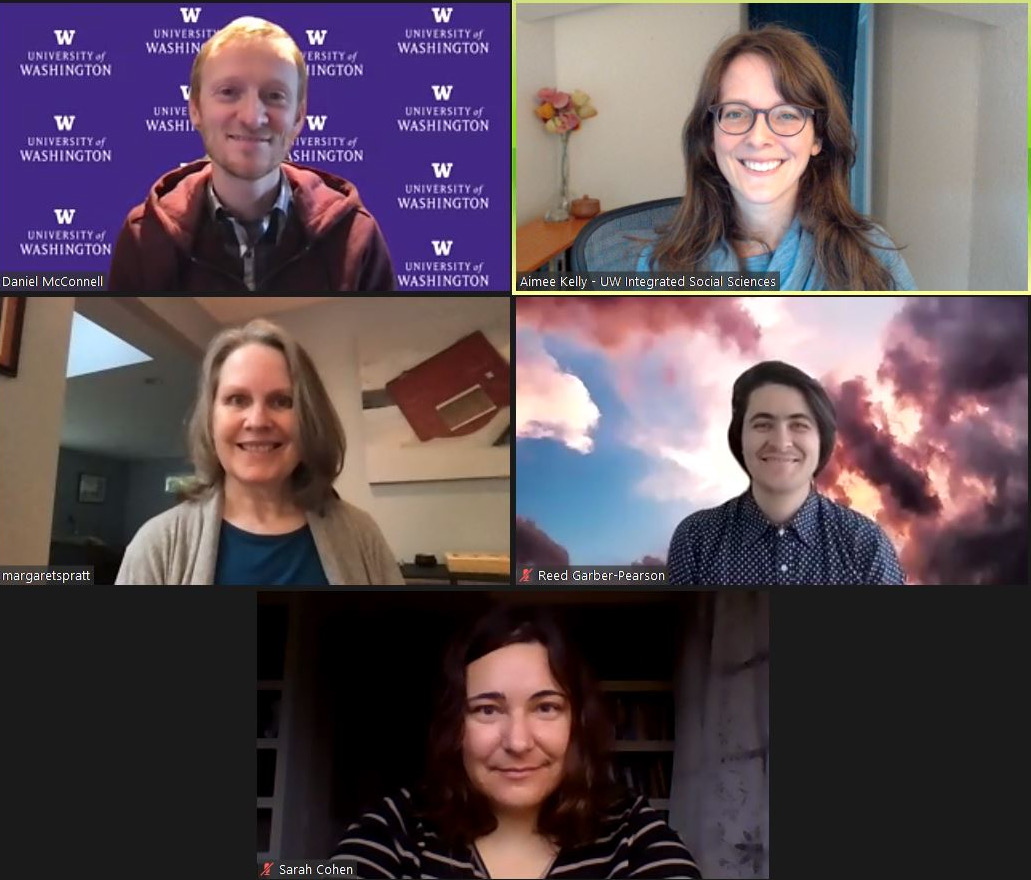
ISS approached this project the way we handle many tasks within our program – through collaborative effort. A small team – primarily from our core curriculum committee – shared responsibility for completing improvements to four core courses throughout summer quarter: ISS 301, ISS 350, ISS 355, ISS 401 as well as our Canvas-based Orientation. The collaboration, which involved instructional designer Sarah Cohen, ISS Librarian Reed Garber-Pearson, Aimee Kelly and Daniel McConnell from ISS Advising, and Meg Spratt, Associate Teaching Professor for ISS, highlighted the value gained by involving people with various roles in the process. Using Canvas’ embedded Accessibility Checker, we identified and prioritized improvements, such as remediating our PDFs and Word documents, ensuring our header hierarchies were correct, and adding alt text for images. During the autumn quarter, we began work on accessibility improvements to ISS 302.
Sarah, Reed, and Aimee completed a poster presentation for the upcoming UPCEA 2021 Summit for Online Leadership and Administration + Roundtable (SOLA+R) Virtual Conference this February 2-4th, highlighting the benefits of and lessons learned through our collaboration.
We view our accessibility improvements as an ongoing project requiring a long-term commitment and investment. Our future projects will include expanding our attention to other program resources, including our website, as well as pedagogical considerations that go beyond the Accessibility Challenge to develop multiple ways of completing certain assignments while preserving the same learning outcomes. We are also in exploring ways we can support our students’ awareness of and skillset around digital accessibility.
New Opportunities: Accessibility from a Librarian Perspective
By Reed Garber-Pearson, ISS Librarian
In early March 2020, most of our lives came to a halt. For many of us who went to work in an office or attended classes in-person, our ways of interacting and performing changed significantly. I witnessed colleagues in the Libraries struggle to adapt to being home instead of in their designated offices, learn new software like Slack and Zoom to communicate more efficiently asynchronously, and learn new social cues from a distance and over a screen. Accessibility for so many of us before the pandemic was something we knew needed to happen eventually for the sake of those with disabilities. Now for all of us, it’s a cornerstone of our interactions. This is a time to leverage the crisis of COVID-19 to provide new ways of working and understanding one another, and building our workflow around accessible content and communications.
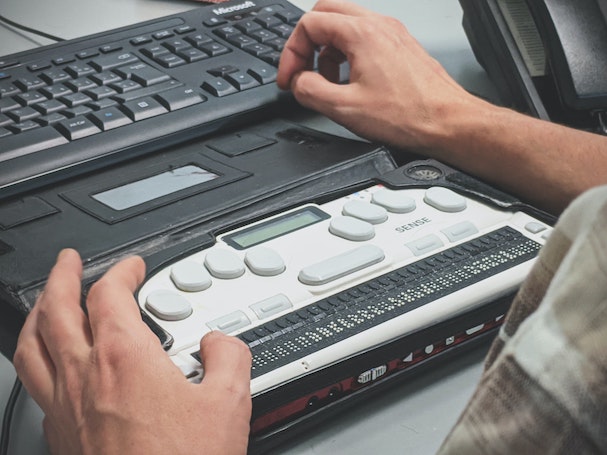
ISS students, staff and faculty have already been using the Libraries in a way that much of the campus has struggled to adapt. Overnight, print books and articles became irrelevant as all 16 of the UW Libraries closed indefinitely. Students no longer had access to the physical spaces to study. What does the Library become once we are no longer a building with books? But for the ISS program, the Libraries have never been primarily about books and study spaces. We have long seen and experienced the benefits of the embedded librarian model, where the librarian is part of the workflow of teaching and research. We focus on student success, relationship-building, and co-learnings. Our integrated ISS model is now being adapted more thoroughly as librarians are helping faculty members develop course content, co-teach, provide research consultations online, and hold virtual office hours. Our capacities for supporting students, faculty and staff in learning has increased as our focus from the physical and synchronous has diminished.
Not all disabilities are visible, and disability is not a trait that can be isolated into one way of being. How we see, hear, think, and move affects how we learn. And when technologies and systems privilege certain ways of doing, we disadvantage many learners. The switch to all online learning has been an important challenge and opportunity for faculty and staff across the university to consider the accessibility of learning content, strategy and pedagogy. I feel so proud to be a part of a program that continues to remediate and change our content based on universal design and accessible learning principles.
For a list of accessibility changes at the UW Libraries, check out our Progress Timeline.
Recognizing Ableism as Part of Accessibility
By Janine Slaker, ISS Assistant Teaching Professor
As a scholar, I understand accessibility as marking a relationship between privilege and social difference. Dis/ability, like other forms of social difference such as race or gender, is often explained as the degree to which someone or some aspect of one’s lived experience deviates from an imagined normative, able-body. When difference is positioned as a deficit it stigmatizes people as problems that need solving. The risk then are solutions oriented to molding differences so that it fits within ableist assumptions of interaction that can marginalize and silence.

Recognizing ableism influences how I approach instruction, which is to consider accessibility as a matter of creating an equitable learning environment that supports multiple learning needs. This is done via technical accessibility such as making sure course material is compatible with assistant technologies (e.g., screen readers, closed caption). I also present material via various modes such as audio, video, and text as well as providing multiple types of assignments so to not privilege one form of evaluation over another.
Considering accessibility as a project of equity also comes with ensuring course material is representative of different voices, social positions, and cultures so to encourage an inclusive learning environment that’s considerate of varying structural barriers and personal histories that affect the learning process. Recognizing barriers also entails the recognition of the limits of my perspective and knowledge. If a student identifies a prejudice in the course design or instruction, I listen and adapt as to recognize their agency and to respect students’ expertise of their requirements and experiences.
Higher education plays an important role in making a more equitable society yet a number of barriers persist that make higher education inaccessible, which can come at the cost of opportunities for financial wellbeing, exposure to diverse groups of people, and growth of social capital. Being an instructor affords me a great deal of privilege, and I am committed to using my privilege to lessen such barriers so that higher education is more accessible so to better represent and be equipped to address the needs of our diverse communities.
Haiku
In the fall, we invited ISS students to submit poetry in the form of haiku for inclusion in this edition of the newsletter. We received a number of great submissions, thank you!
|
Nonexistent fall - Anonymous |
new learning is strange - Jake |
A place of refuge - Jake |
|
Frigid wintertime - Anonymous |
Seven pointed star - Anonymous |
Have homework due - Jake |
Bulletin Board:
Calendar:
Here are some important dates, as well as a link to the UW academic calendar:
- Period I Spring registration opens February 17 - 23, based on class standing.
- ISS orientation will welcome new ISS students beginning on March 08.
- Winter quarter classes end on March 12, exams the week following.
- Spring quarter classes start on March 29.
- Graduates, save the date! The virtual ISS graduation celebration will take place on the morning of Sunday, June 13, 2021.
Fantastic Faculty:
-
UW Department of Sociology professor and ISS faculty member, Alexes Harris, was recently quoted in a report by the Seattle Times: Black Washingtonians question disparate treatment in images of white extremists storming Capitol
Standout Staff:
- Aimee Kelly was invited to participate on UW’s IT Accessibility Task Force as a result of her work to raise campus awareness about accessibility and its intersection with online advising and virtual graduation events.